Match the guard to what lands on your roof
A gutter guard is a filter, and a filter only works when it's matched to what you're trying to keep out. In the north Denver metro that usually means some mix of pine needles, cottonwood fluff, maple and ash leaves, and the fine grit that washes off asphalt shingles. Most houses get more of one than the others, and that's the one your guard has to handle.
The quickest way to find out is to look before you shop. Pull a handful of debris from a corner or near a downspout outlet and see what you've got. Needles standing on end, a gray felt of old fluff, gritty sand along the bottom, and a mat of half-rotted leaves each point toward a different answer.
Homes on the west side of Arvada and along the foothill edge of Boulder sit under ponderosa pines, while older neighborhoods in Wheat Ridge and Lafayette have big cottonwoods, elms, and silver maples. A newer house on open ground may have hardly any trees nearby and still collect plenty of shingle grit.
Pine needles call for micro-mesh
Needles are the debris that gets past most cheap covers. They're long and thin, so they slip endwise into slots and holes that would stop a leaf, then stand up inside the trough and catch everything that comes after them. Give that a full season and the gutter can be packed solid.
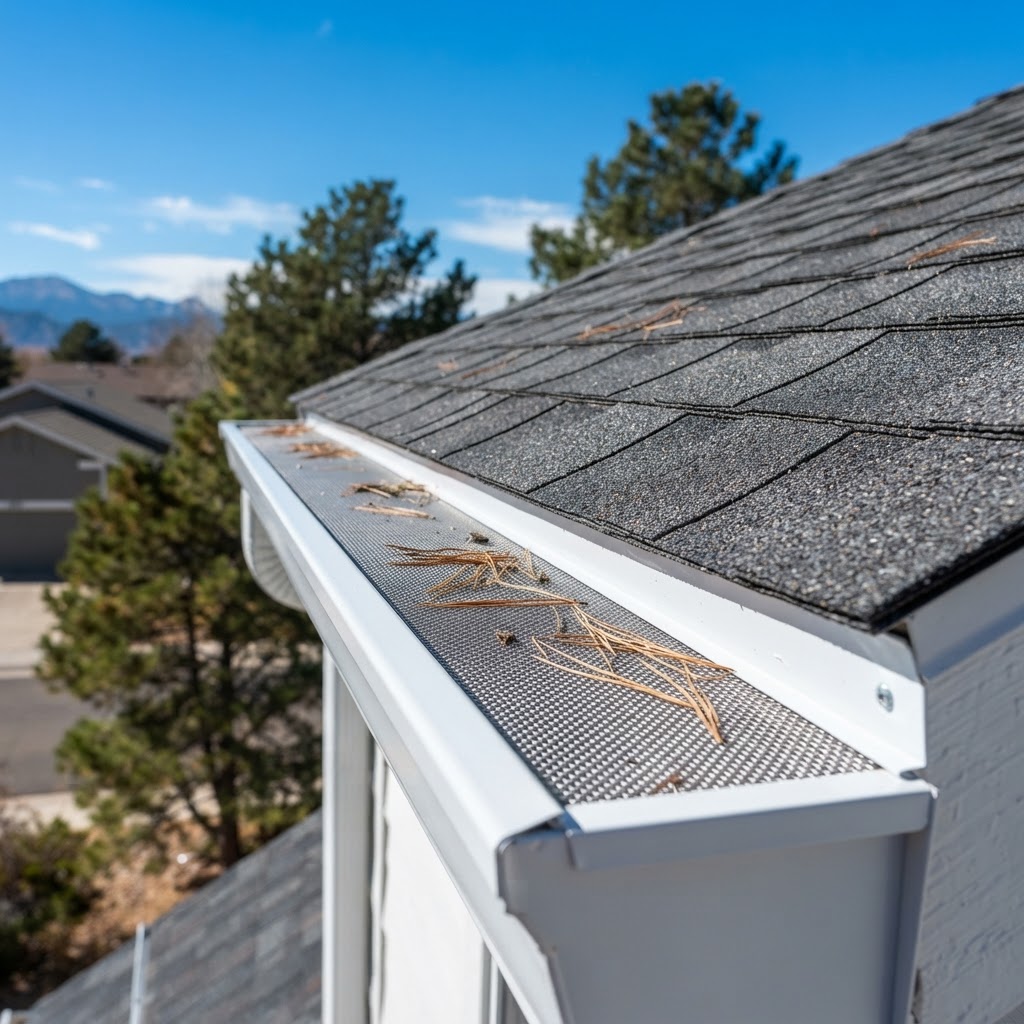
Micro-mesh guards use a screen fine enough that needles lie on top instead of poking through. Needles that land there tend to dry out and blow away, and the rest come off when you rinse the surface. That's why Ethan uses micro-mesh where needles and other fine debris are the main problem.
Expect micro-mesh to cost more than a perforated cover. Where pine needles are the problem, it's worth the difference, because a cover that lets needles through just moves the clog under a lid where it's harder to reach.
Cottonwood fluff every June
Cottonwoods let go of their fluff in early summer, and on some streets it drifts along the curb like snow. In an open gutter it soaks up water, tangles with seeds and leaf bits, and dries into a felt that plugs downspout outlets.
With a guard on, the fluff stays on top of it. Dry fluff usually blows away on its own, but a wet mat can sit across a fine screen and slow water down until it dries or gets rinsed off. A quick look at your guards once the cottonwoods are finished is worth adding to the early-summer list.
Shingle grit, the debris you can't see from the ground
Every asphalt roof sheds granules. Rain carries them into the gutter, where they sink to the bottom and mix with fine leaf litter into a dark sludge that's heavier than it looks. After a Front Range hailstorm you'll often find granules piled at the downspout outlets, and a newly replaced roof sheds loose ones for a while too.
Grit is fine enough to pass through the openings in a perforated cover, so a leaf cover alone won't keep it out of the trough. Micro-mesh stops most of it on the surface, where a rinse with the hose clears it. If grit makes up a big share of what you pull out of your gutters, that tilts the choice toward mesh even when there isn't a pine tree in sight.
Leaves, and when a perforated cover is enough
If your trouble is mostly maple, ash, or elm leaves and there are no pines nearby, a perforated aluminum cover is often the right fit. Leaves are big enough to sit on top, dry out, and blow off, and a properly fitted cover takes a hard Front Range downpour without sending water over the edge.
Sometimes the gutter drains fine and the real trouble is one outlet that keeps plugging. A downspout filter at that outlet can fix it without covering the whole run.
Be wary of foam and brush inserts. Cheap ones can send water over the front in a heavy rain, and needles tend to snag in brush bristles and stay there.
Even the right guard needs a little attention. The difference is the size of the job: a quick rinse of the top surface about once a year instead of scooping muck out twice a year from a ladder.
Finding the right fit for your house
Gutter guards from Stoked Property Solutions start with a free on-site estimate, where Ethan looks at what's landing on your roof and checks that your gutters are sound enough to carry guards. If your house doesn't need guards, you'll get a straight answer on that too.
More articles
- Fall Gutter Cleanout Checklist for Front Range HomesPut a hose at the far end of each cleaned gutter. Where the water pools, the run has lost its pitch or is sagging, and that spot ices up first.
- How Gutter Guards Handle Colorado Snow and IceGuards keep debris out so gutters can drain during a thaw. They won't stop ice dams on their own, and the way a guard attaches matters in wind and snow.